Welcome to Max' Foreground Center
Shop here for models, data and fortran code
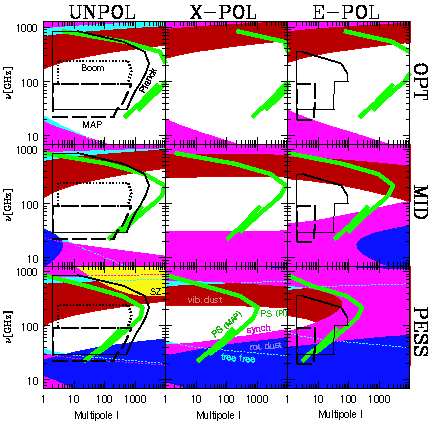 Figure 7: The colored regions show the frequencies and
angular scales where different foregrounds dominate over the microwave
bacground fluctuations that we are trying to measure. The different panels
are for our three scenarios and various polarization types.
Figure 7: The colored regions show the frequencies and
angular scales where different foregrounds dominate over the microwave
bacground fluctuations that we are trying to measure. The different panels
are for our three scenarios and various polarization types.
What's a foreground?

 The cosmic microwave background (CMB) is a goldmine of cosmological information,
and has the potential to answer important questions about the origin and
fate of the Universe. Exciting experiments are currently measuring it with
increasing accuracy. The potential party-pooper is foregrounds, contamination
of the pristine cosmological signal by microwave-emitting junk, for instance
dust, free-free and synchrotron radiation from our galaxy and extragalactic
objects. This page contains a detailed model of such foregrounds, described
in the paper astro-ph/9905257
by Max Tegmark, Daniel Eisenstein, Wayne Hu and Angelica de Oliveira-Costa.
This monstrously long paper also describes a method for removing foregrounds
and computes the accuracy to which cosmolological parameters should be
measurable in the end. Please click here
to get the 660K compressed postscript file with the paper. To download
a color postscript file with the figure above, just click on it.
Click if you
are interested in other research of mine.
The cosmic microwave background (CMB) is a goldmine of cosmological information,
and has the potential to answer important questions about the origin and
fate of the Universe. Exciting experiments are currently measuring it with
increasing accuracy. The potential party-pooper is foregrounds, contamination
of the pristine cosmological signal by microwave-emitting junk, for instance
dust, free-free and synchrotron radiation from our galaxy and extragalactic
objects. This page contains a detailed model of such foregrounds, described
in the paper astro-ph/9905257
by Max Tegmark, Daniel Eisenstein, Wayne Hu and Angelica de Oliveira-Costa.
This monstrously long paper also describes a method for removing foregrounds
and computes the accuracy to which cosmolological parameters should be
measurable in the end. Please click here
to get the 660K compressed postscript file with the paper. To download
a color postscript file with the figure above, just click on it.
Click if you
are interested in other research of mine.
Stuff to download
-
The whole package in a single gzipped tar file
(recommended if you're un a unix machine)
-
The fortran code foregmodel.f and
the include files foreg_common.f,
chan_common.f, cmb_common.f
& physics_common.f
-
Foreground specification files for the optimistic,
middle-of-the-road and pessimistic
scenarios. The meaning of the parameters is explained in the paper. These
three files give the models of our table 2, but you can of course change
the numbers as you find appropriate before feeding the file to our software.
-
Experimental specification files for Boomerang,
MAP and Planck.
The four columns give the specifications for each channel: the frequency
in GHz, the angular resolution (FWHM in arcminutes), the unpolarized and
polarized sensitivities (10^6 times dT/T), just as in table 1 of the paper.
The first line gives the useful sky fraction, although this is in fact
never used by the parts of the code you'll find here.
-
The CMB model used in the paper (you
can compute your own with CMBfast)
-
The point source source count model of
Toffolatti et al 1998
What it does
The software evaluates the covariance matrix between different frequencies
and polarization types as a function of angular scale. It includes demo
subroutines that ourput some useful special cases such as
-
The power spectrum C_l for each foreground
-
The frequency dependence of each foreground
-
The rms foreground contribution to each channel of an experiment
-
Contours in the nu-ell plane
The code includes internal point source cleaning using source
count models kindly provided by Luigi Toffolatti and his collaborators.
The code should be pretty self-explanatory. It simply takes three files
as input: one specifying the foreground model (e.g. mid_foregmodel.dat),
one specifying the experiment (e.g. planck_specs.dat) and one specifying
the assumed CMB model (e.g. lcdm_Cl.dat). You'll find sample input files
above. The format of the CMB model is simply the format of CMBfast
output, so it's easy to generate your own.
What it doesn't do
If you're interested (please email me if you are), I can tidy up more parts
of the code used for our paper and put it here. It computes cleaned power
spectra, attainable accuracy on cosmological parameters, etc.
The fine print
The package is public domain, which means that you may use it freely for
any purpose whatsoever.
If you find it useful, we appreciate if you include an acknowledgement
in publications that make use of it.
So here it is at last - our ridiculously long paper
containing only 141 figure panels:
Foregrounds and Forecasts for the Cosmic Microwave Background
Authors:
Max Tegmark, Daniel
Eisenstein, Wayne
Hu & Angelica
de Oliveira-Costa
Abstract:
One of the main challenges facing upcoming CMB experiments will be to distinguish
the cosmological signal from foreground contamination. We present a comprehensive
treatment of this problem and study how foregrounds degrade the accuracy
with which the Boomerang, MAP and Planck experiments can measure cosmological
parameters. Our foreground model includes not only the normalization, frequency
dependence and scale dependence for each physical component, but also variations
in frequency dependence across the sky. When estimating how accurately
cosmological parameter can be measured, we include the important complication
that foreground model parameters (we use about 500) must be simultaneously
measured from the data as well. Our results are quite encouraging: despite
all these complications, precision measurements of most cosmological parameters
are degraded by less than a factor of 2 for our main foreground model and
by less than a factor of 5 in our most pessimistic scenario. Parameters
measured though large-angle polarization signals suffer more degradation:
up to 5 in the main model and 25 in the pessimistic case. The foregrounds
that are potentially most damaging and therefore most in need of further
study are vibrating dust emission and point sources, especially those in
the radio frequencies.
It is well-known that E and B polarization contain
valuable information about reionization and gravity waves,
respectively. However, the cross-correlation between polarized
and unpolarized foregrounds also deserves further study, as we
find that it carries the bulk of the polarization information
about most other cosmological parameters.
Reference info:
astro-ph/9905257,
ApJ, 530, 133-165
Comment:
This removal method, first derived here, generalizes
and supersedes the multifrequency Wiener filtering method of Tegmark
& Efstathiou (1996) and Bouchet et al (1996).
Other foreground resources:
General CMB links:
 Return to my home page
This page was last modified September 19, 2002.
max@physics.upenn.edu